
One Shed, One Budget: Choosing Between LTC and BTC at Fixed Power
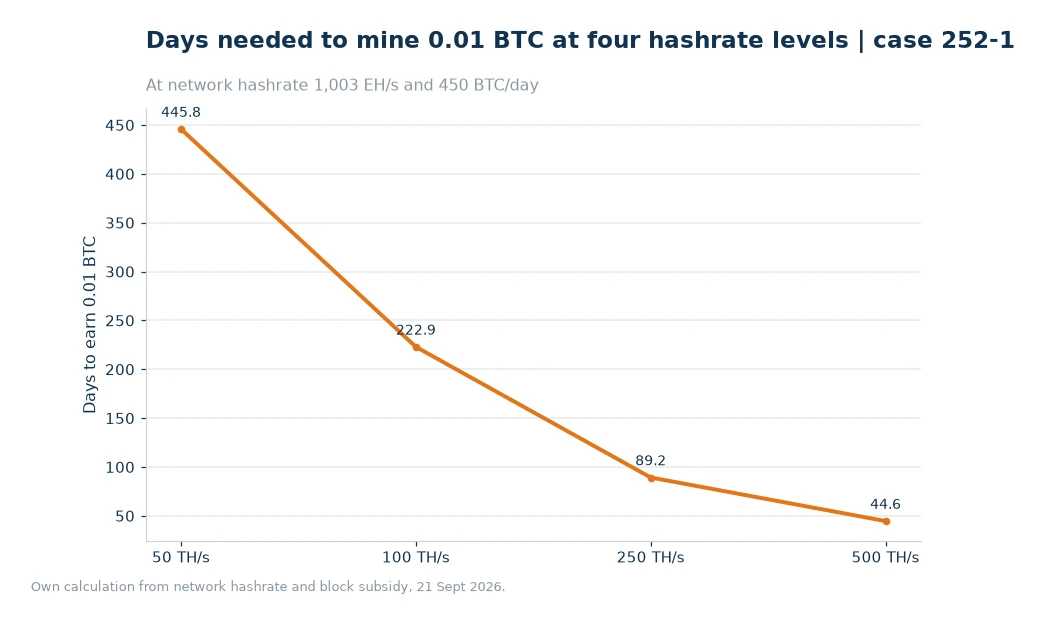
A shed with a 2 kW supply makes the choice for you. At 20 J/TH that budget supports about 100 TH/s of SHA-256 hardware, which needs 222.9 days to produce 0.01 BTC at the 21 September 2026 network total. Double the supply and the wait halves; at 10 kW it falls to 44.6 days. Before comparing algorithms, compare what the building can deliver.

Key takeaways
- A 2 kW supply supports roughly 100 TH/s at 20 J/TH, which takes 222.9 days to reach 0.01 BTC.
- Every algorithm has to fit the same socket, so the power budget filters hardware before yield does.
- LTC and BTC differ in network, price and fee rhythm, not in the arithmetic of share.
- Merged mining adds a second coin stream on the Scrypt side, which is a real difference at equal watts.
The Decision Is About Watts, Not Algorithms
A shed has a supply, a ventilation path and a noise limit. Those three constraints do not care which coin the hardware mines. They set a ceiling on how many joules per second can be spent, and every machine on the shortlist has to fit under it. Starting with the algorithm leads to a shortlist that cannot be plugged in.
Once the wattage is fixed, the comparison becomes a question of efficiency and revenue per joule. Efficiency is a specification, and revenue per joule depends on the coin, the network and the pool. The first is stable, the second is not, which is why the shed should be sized around the stable part.
What the Same Target Costs in Time
At 50 TH/s a 0.01 BTC goal takes 445.8 days; at 100 TH/s it takes 222.9; at 250 TH/s, 89.2; and at 500 TH/s, 44.6. Those are the same four points the chart plots, and they are the only honest way to describe a target that depends on share rather than on effort.
The pattern is linear even though the numbers look dramatic. Doubling the hash rate halves the time. The drama comes from starting at a small base, where a single machine represents a tiny fraction of a very large network.
Scrypt Versus SHA-256 at the Socket
Scrypt machines and SHA-256 machines have different efficiency curves, different prices and different resale markets. They also have different networks, so a given number of hashes represents a different share on each chain. That means a kilowatt spent on one algorithm is not interchangeable with a kilowatt spent on the other; the comparison has to be made per coin, not per hash.
For a shed operator the practical consequence is that the decision should be made with the pool's own calculator for each candidate, using the same power budget in both cases. Comparing headline hash rates across algorithms is meaningless because the units and the networks differ. Compare the coin each candidate would produce from the same kilowatts over the same month, and let the hardware price settle the rest.
The Pool Numbers to Compare
The ViaBTC LTC Mining Pool view gives the Scrypt side of the comparison, and the same site publishes Bitcoin pool figures on the same basis. Read both on the same day, because a comparison across two weeks is a comparison of conditions rather than of pools.
Check Pool Luck as well. It tells you whether recent block discovery has been above or below expectation, which explains a difference in credited coins that the hash rate cannot. For an operator choosing between schemes, a month of luck data is more informative than a day of headline rate.
The Statistics page carries the network figures for each coin, while the Profit Calculator handles the per-coin arithmetic, including the merged output where it applies, so both candidates can be run through the same formula.
Merged Mining as a Tiebreaker
On the Scrypt side, merged mining means the same work can earn two coins. At equal power and equal efficiency, that is a genuine advantage over a single-coin setup, though it is not a guarantee of higher revenue because both coins have their own markets.
The advantage is easiest to see in the statement: two lines where the other side has one. For a small shed, that diversification is worth something even before the numbers are compared, because it reduces dependence on a single price without requiring a second machine.
A Budget That Survives One Bad Month
Size the installation so that a bad month does not force a sale. If the power bill and the coin revenue cross for four weeks, the operator should still be able to keep the machines running until conditions change. That usually means leaving 20% to 30% of the supply unused rather than filling it on day one.
The spare capacity also makes maintenance cheaper: a failed machine can be swapped without exceeding the breaker, and a replacement can be tested before the old unit is sold. A shed running at 100% of its supply has no room for either. Ventilation deserves the same margin, because a hot week can force a lower clock on every machine at once, and that loss arrives without any hardware failing.
Write the budget as a range rather than a single figure. "Between 1.6 and 2.0 kW continuous" tells an electrician what to design for and gives the operator a number to check against a clamp meter in July. A single number invites the installation to fill every spare amp on the first warm day.
| Supply budget | Hash rate at 20 J/TH | Days to 0.01 BTC | Energy per day |
|---|---|---|---|
| 1.0 kW | 50 TH/s | 445.8 | 24 kWh |
| 2.0 kW | 100 TH/s | 222.9 | 48 kWh |
| 5.0 kW | 250 TH/s | 89.2 | 120 kWh |
| 10.0 kW | 500 TH/s | 44.6 | 240 kWh |
Worked example
The 2 kW shed, costed from the socket to the coin.
- Available power: 2,000 W at 20 J/TH gives 2,000 ÷ 20 = 100 TH/s.
- Daily issuance: 144 × 3.125 = 450 BTC across 1,003,000,000 TH/s.
- Per terahash: 0.00000044865 BTC; at 100 TH/s that is 0.00004487 BTC a day.
- Days to 0.01 BTC: 0.01 ÷ 0.00004487 = 222.9.
- Energy: 2 kW × 24 = 48 kWh a day.
- Energy over the run: 48 × 222.9 = 10,699 kWh.
- At $0.06/kWh that is $641.94, against 0.01 BTC worth $846.92 at $84,692.
- The margin before hardware and pool fees is $204.98 for the whole run, which is what the machine has to fit inside.
Frequently asked questions
How much hash rate can a shed supply support?
Divide the usable wattage by the machine's efficiency. A 2 kW continuous budget at 20 J/TH supports about 100 TH/s, before allowing headroom for fans, power-supply losses and anything else on the same circuit.
Is LTC more profitable than BTC for a small operator?
There is no general answer, because it depends on hardware price, power cost and both networks at the time of purchase. Run each candidate through the same calculator with the same wattage and compare the coin output, not the headline hash rate.
Does merged mining change the power requirement?
No. The additional coin comes from work already being submitted, so the watts are unchanged. What changes is the revenue mix and the number of lines to reconcile each week.
Size the Shed, Then the Machine
Measure the supply, subtract the headroom, then divide by the efficiency of the machines on the shortlist. That produces a hash-rate range the building can actually run. The Profit Calculator and the pool pages then answer what that range earns on each algorithm, and the Miner Profitability Ranking shows which models fit the range.
Whichever coin wins, the shed stays the same. That is why the electrical plan should be settled first and the hardware bought second, rather than the other way round. A shed built around a machine is a shed that will need rebuilding when the machine changes.
Basis: ViaBTC LTC pool, calculator and statistics pages[1], read 21 Sept 2026. Network 1,003 EH/s; difficulty 132.76 T; 3.125 BTC per block; 144 blocks a day; BTC $84,692; LTC $59.32. Power and tariff numbers are examples only. Published 24 Oct 2026.