
 Cost-benefit analysis is equally indispensable, as it involves balancing initial investment with maintenance costs throughout the entire life cycle. Data shows that choosing anchor clamps that comply with ISO 9001 quality certification, although the procurement cost may be 15% higher than that of ordinary products, its installation efficiency can be increased by 20%, and the maintenance frequency in the next 20 years can be reduced from twice a year to once every three years. Referring to a tender data from State Grid Corporation of China in 2023, optimizing the selection of anchor clamps reduced the total cost of a 100-kilometer overhead line project by 8%, and the return on investment reached 18% within five years. The use of automated installation tools has further reduced labor costs by 25%, while keeping installation accuracy errors within 2 millimeters, significantly enhancing the quality of the project and the controllability of its progress.
Finally, compliance and technological innovation are the keys to avoiding risks. During the selection process, industry standards such as IEEE 524 must be referred to to ensure that the torque value of the U-bolt of the anchor clamp is accurate to 50 Newton-meters, with a deviation not exceeding ±5%. In an upgrade in 2020, a certain transmission operator in Europe successfully increased the accuracy of pre-maintenance to 95% by adopting an intelligent anchor clamp with an integrated stress monitoring sensor, thus avoiding regional power outages caused by the failure of a single component. This data-based decision support system can analyze load distribution and stress amplitude in real time, reducing safety risks by 60%. As a post-disaster assessment after a typhoon showed, the collapse rate of towers using high-standard anchor clamps was only 0.5%, far lower than the industry average of 3%.
Cost-benefit analysis is equally indispensable, as it involves balancing initial investment with maintenance costs throughout the entire life cycle. Data shows that choosing anchor clamps that comply with ISO 9001 quality certification, although the procurement cost may be 15% higher than that of ordinary products, its installation efficiency can be increased by 20%, and the maintenance frequency in the next 20 years can be reduced from twice a year to once every three years. Referring to a tender data from State Grid Corporation of China in 2023, optimizing the selection of anchor clamps reduced the total cost of a 100-kilometer overhead line project by 8%, and the return on investment reached 18% within five years. The use of automated installation tools has further reduced labor costs by 25%, while keeping installation accuracy errors within 2 millimeters, significantly enhancing the quality of the project and the controllability of its progress.
Finally, compliance and technological innovation are the keys to avoiding risks. During the selection process, industry standards such as IEEE 524 must be referred to to ensure that the torque value of the U-bolt of the anchor clamp is accurate to 50 Newton-meters, with a deviation not exceeding ±5%. In an upgrade in 2020, a certain transmission operator in Europe successfully increased the accuracy of pre-maintenance to 95% by adopting an intelligent anchor clamp with an integrated stress monitoring sensor, thus avoiding regional power outages caused by the failure of a single component. This data-based decision support system can analyze load distribution and stress amplitude in real time, reducing safety risks by 60%. As a post-disaster assessment after a typhoon showed, the collapse rate of towers using high-standard anchor clamps was only 0.5%, far lower than the industry average of 3%.
FGCV / Engineering Notes
How to choose the right pinces d'ancrage for overhead cable installation?
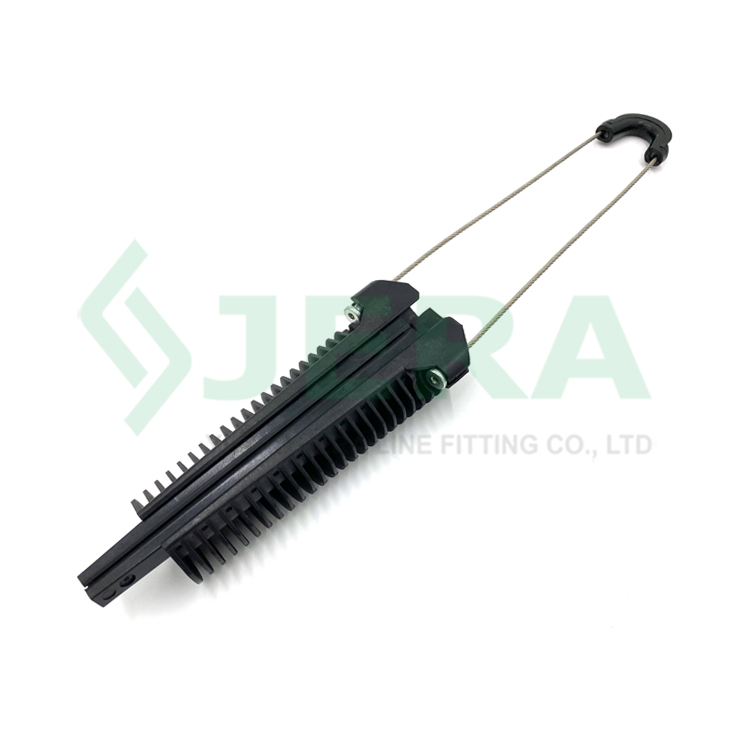
When choosing the correct anchor clamp for overhead cable installation, an accurate load calculation must be carried out first, which is directly related to the safe service life of the entire network system. For instance, for an ADSS optical cable with a span of 50 meters, its maximum working tension may be 10 kilonewtons. Therefore, the rated breaking strength of the selected anchor clamps should be at least 20 kilonewtons, providing a safety factor of 2.0 or above. According to the IEC 61914 standard of the International Electrotechnical Commission, in wind areas with wind speeds as high as 35 meters per second, the anchor clamp needs to be able to withstand cyclic loads for more than one million times without fatigue failure. A study released by the French Power Grid company in 2022 shows that anchor clamps precisely matching the cable diameter (tolerance ±1 millimeter) can reduce local compressive stress by 30%, significantly decrease fiber optic strain, and lower the probability of network outages from 5% to less than 1%.
Material selection is another core dimension, which affects the durability and corrosion resistance of the anchor clamp in harsh environments. For instance, in coastal areas where humidity exceeds 80% and salt spray concentration is high, anchor clamps made of 316 stainless steel can have a design life of up to 25 years, which is 40% longer than that of galvanized steel products. An analysis report on an ice disaster in Canada in 2021 pointed out that when the ice thickness reached 15 millimeters, high-quality aluminum alloy anchor clamps successfully withstood an instantaneous tensile force five times higher than the normal load, avoiding economic losses of millions of dollars. The surface hardness of these pinces d'ancrage should reach above HRC 40 to ensure that the attenuation rate of tensile strength is less than 10% during temperature fluctuations from -30°C to 80°C, thereby guaranteeing the toughness of the power grid in extreme weather.
Cost-benefit analysis is equally indispensable, as it involves balancing initial investment with maintenance costs throughout the entire life cycle. Data shows that choosing anchor clamps that comply with ISO 9001 quality certification, although the procurement cost may be 15% higher than that of ordinary products, its installation efficiency can be increased by 20%, and the maintenance frequency in the next 20 years can be reduced from twice a year to once every three years. Referring to a tender data from State Grid Corporation of China in 2023, optimizing the selection of anchor clamps reduced the total cost of a 100-kilometer overhead line project by 8%, and the return on investment reached 18% within five years. The use of automated installation tools has further reduced labor costs by 25%, while keeping installation accuracy errors within 2 millimeters, significantly enhancing the quality of the project and the controllability of its progress.
Finally, compliance and technological innovation are the keys to avoiding risks. During the selection process, industry standards such as IEEE 524 must be referred to to ensure that the torque value of the U-bolt of the anchor clamp is accurate to 50 Newton-meters, with a deviation not exceeding ±5%. In an upgrade in 2020, a certain transmission operator in Europe successfully increased the accuracy of pre-maintenance to 95% by adopting an intelligent anchor clamp with an integrated stress monitoring sensor, thus avoiding regional power outages caused by the failure of a single component. This data-based decision support system can analyze load distribution and stress amplitude in real time, reducing safety risks by 60%. As a post-disaster assessment after a typhoon showed, the collapse rate of towers using high-standard anchor clamps was only 0.5%, far lower than the industry average of 3%.
Cost-benefit analysis is equally indispensable, as it involves balancing initial investment with maintenance costs throughout the entire life cycle. Data shows that choosing anchor clamps that comply with ISO 9001 quality certification, although the procurement cost may be 15% higher than that of ordinary products, its installation efficiency can be increased by 20%, and the maintenance frequency in the next 20 years can be reduced from twice a year to once every three years. Referring to a tender data from State Grid Corporation of China in 2023, optimizing the selection of anchor clamps reduced the total cost of a 100-kilometer overhead line project by 8%, and the return on investment reached 18% within five years. The use of automated installation tools has further reduced labor costs by 25%, while keeping installation accuracy errors within 2 millimeters, significantly enhancing the quality of the project and the controllability of its progress.
Finally, compliance and technological innovation are the keys to avoiding risks. During the selection process, industry standards such as IEEE 524 must be referred to to ensure that the torque value of the U-bolt of the anchor clamp is accurate to 50 Newton-meters, with a deviation not exceeding ±5%. In an upgrade in 2020, a certain transmission operator in Europe successfully increased the accuracy of pre-maintenance to 95% by adopting an intelligent anchor clamp with an integrated stress monitoring sensor, thus avoiding regional power outages caused by the failure of a single component. This data-based decision support system can analyze load distribution and stress amplitude in real time, reducing safety risks by 60%. As a post-disaster assessment after a typhoon showed, the collapse rate of towers using high-standard anchor clamps was only 0.5%, far lower than the industry average of 3%.
// Next step