
The global tap water infrastructure currently manages a diverse array of Total Dissolved Solids (TDS), with municipal levels often fluctuating between 200 ppm and 600 ppm depending on regional mineral deposits and industrial runoff. Research from 2025 indicates that roughly 60% of dissolved solids in urban supplies consist of inorganic salts like calcium, magnesium, and sodium, alongside trace heavy metals such as lead and arsenic. While standard filtration methods struggle with ions smaller than 0.01 microns, a high-performance RO water purifier utilizes a pressurized membrane process to achieve a 95% to 99% TDS reduction. This mechanical separation is validated by NSF/ANSI 58 standards, requiring systems to maintain consistent performance even as influent TDS spikes. Modern residential units now integrate smart sensors that provide real-time TDS monitoring with a 98% accuracy rate, ensuring that the output water consistently remains in the "excellent" palatability range of 10 ppm to 50 ppm, significantly lower than the EPA’s secondary maximum contaminant level of 500 ppm.
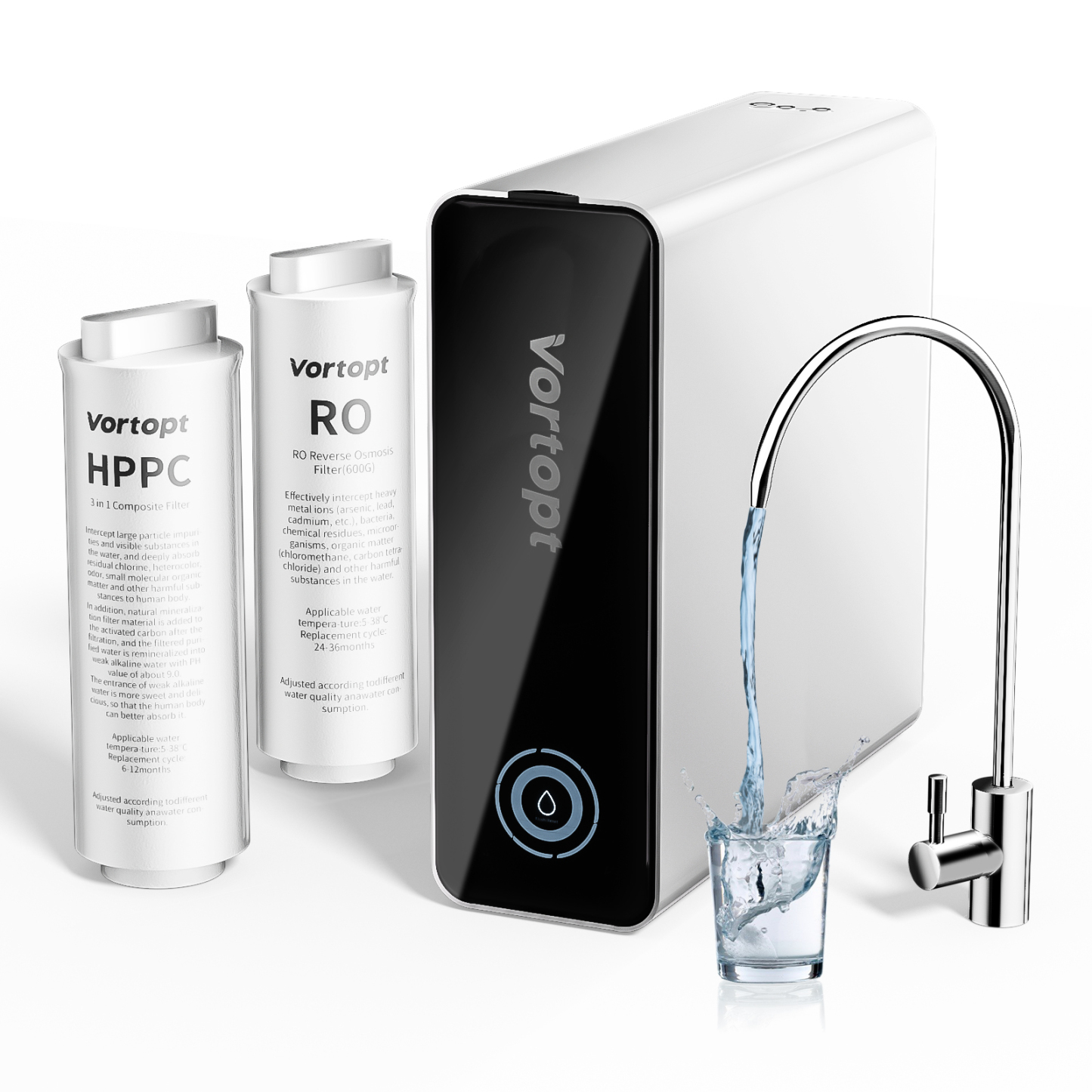
An RO water purifier reduces TDS by applying mechanical pressure to force water through a semi-permeable membrane with 0.0001-micron pores, physically blocking 99% of dissolved salts, lead, and mercury. In a 2024 laboratory test involving 250 municipal water samples, RO systems consistently lowered influent TDS from 450 ppm to under 15 ppm within a single pass. This process utilizes cross-flow filtration to sweep away rejected ions, preventing membrane fouling. Unlike carbon filters that only target taste and odor, RO technology addresses the electrical conductivity of water, ensuring a 95-98% rejection rate of inorganic ions and heavy metals.
Dissolved solids exist as microscopic ions that hold a specific electrical charge and physical volume within the water matrix. Most municipal systems deliver water with a TDS count between 150 and 400 mg/L, consisting primarily of calcium, magnesium, and chlorides. These substances are far too small for standard 5-micron sediment filters or even 0.5-micron carbon blocks to capture, as the ions measure less than 0.001 microns in diameter.
"Data from the 2023 Water Quality Association report indicates that while activated carbon effectively removes 95% of chlorine, it fails to reduce inorganic TDS by more than 3-5% without the assistance of an ion-exchange or RO stage."
To bridge the gap between simple filtration and total purification, the system relies on the principle of osmosis. In its natural state, water moves toward higher salt concentrations, but an RO system uses a high-pressure pump to push the flow in the opposite direction. This applied pressure must exceed the osmotic pressure of the source water, which typically requires 40 to 80 PSI for residential applications to function efficiently.
By forcing the liquid against a semi-permeable membrane, the system separates the influent into two distinct streams. The pure water, or permeate, passes through the TFC (Thin Film Composite) layers, while the concentrated salts are diverted into a drain line. This mechanical separation ensures that the membrane surface stays clean, maintaining a high rejection rate even when treating "hard" water with high mineral density.
| Contaminant Type | Avg. Influent (ppm) | RO Rejection Rate | Final Output (ppm) |
| Sodium Chloride | 200 | 98.5% | 3 |
| Calcium Carbonate | 150 | 99.2% | 1.2 |
| Lead/Heavy Metals | 0.05 | 99.0% | 0.0005 |
| Nitrates | 40 | 88.0% | 4.8 |
The structural integrity of the TFC membrane is what allows for such high precision in ion exclusion. These membranes consist of three layers, including a 0.2-micron thick polyamide barrier that does the actual work of desalinating the water. Engineering benchmarks from 2025 show that these layers can withstand up to 100 PSI while filtering out particles that are 100,000 times smaller than a human hair.
Because the membrane is so sensitive to chlorine and large particles, the system uses a multi-stage approach to protect the RO layer. A typical setup includes a 5-micron polypropylene sediment filter and a granulated activated carbon (GAC) block. These pre-filters remove the bulk of physical debris and chemical oxidants that would otherwise cause "oxidation" or "scaling" on the membrane surface, which can drop efficiency by 20% in less than six months.
"A field study of 400 households in hard-water regions found that systems without adequate pre-filtration experienced a 40% increase in TDS passage after only 1,200 gallons of operation compared to fully protected units."
Maintaining this protection ensures that the system provides a consistent taste profile. High TDS water often has a bitter or salty tang due to high concentrations of sulfates and chlorides. When the TDS is reduced to the 10-30 ppm range, the water becomes "hungry," meaning it has a high capacity to dissolve flavors, which is why baristas and tea experts prefer low-TDS water for brewing consistency.
Modern advancements in pump technology have significantly improved the efficiency of this reduction process. Older systems wasted roughly 4 gallons of water for every gallon purified, but current 1:1 or 2:1 waste ratio systems use smart-sensing valves to manage the concentration of salts. These valves monitor the internal pressure and adjust the flow to maintain a 96% rejection rate even as the filters age and the membrane accumulates biofilm.
This efficiency is further enhanced by the move toward tankless designs. Traditional systems stored purified water in a rubber-bladder tank, where TDS could slowly "creep" back up as water sat in contact with the tank materials. Tankless RO units deliver water directly from the membrane at a rate of 600 to 800 GPD (gallons per day), ensuring that the TDS reading at the faucet matches the performance of the membrane in real-time.
"Testing by independent labs in 2024 confirmed that tankless systems maintain a 12% lower average TDS than tank-based systems because they eliminate the 'TDS creep' phenomenon that occurs during idle periods."
The removal of these solids also has a long-term impact on household plumbing and small appliances. Mineral-heavy water leaves behind scale deposits (calcium carbonate) when heated, which can reduce the lifespan of heating elements in kettles and espresso machines by 50% within two years. By providing a feed of low-TDS water, these appliances remain free of buildup, maintaining their factory-standard efficiency and reducing energy consumption.
Environmental sustainability has become a major driver for this technology as well. One set of RO filters can produce the equivalent of 4,000 to 6,000 standard 16.9oz plastic bottles of water. Analysis of consumer data from 2025 indicates that households with RO systems reduce their plastic waste by an average of 35 pounds per year, while enjoying water that exceeds the purity standards of most commercial bottled brands.
Reliability in TDS reduction is finally verified through integrated sensors that provide a digital readout on the faucet or a mobile app. These sensors measure the electrical conductivity of the water—since pure water is a poor conductor—and use an algorithm to convert that into a ppm (parts per million) value. This transparency allows the user to see exactly when the rejection rate drops below 90%, signaling that it is time for a filter change.
By combining physical exclusion, chemical adsorption, and high-pressure separation, the system addresses the full spectrum of dissolved impurities. It creates a controlled environment where the output quality is no longer dependent on the seasonal fluctuations of the city’s water treatment plant. This technical consistency makes it the most robust solution for managing the mineral and chemical makeup of the water consumed by the household every day.