
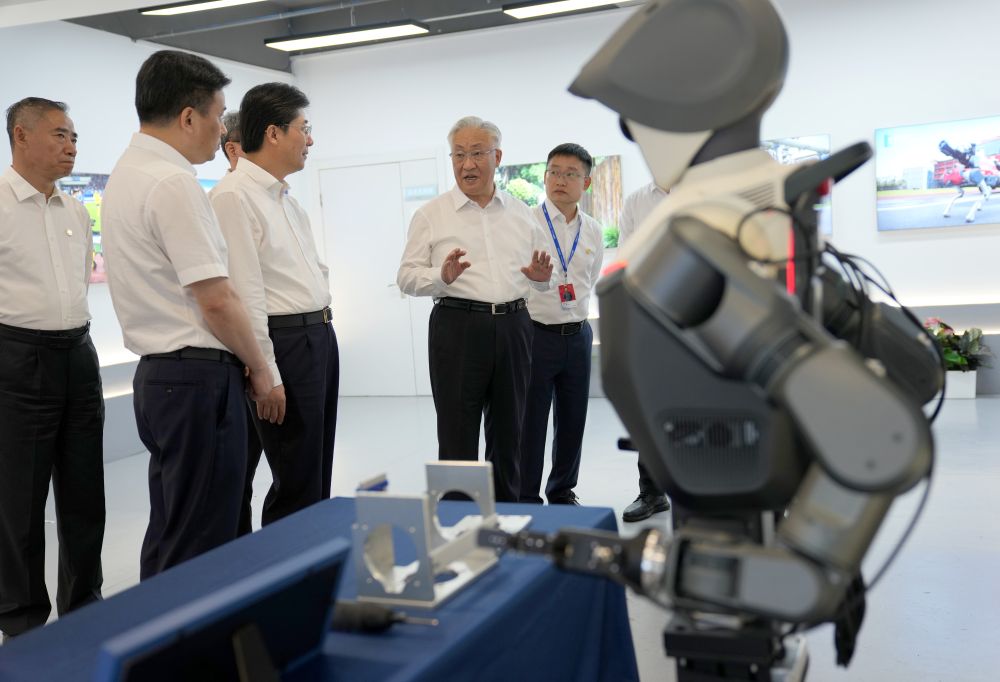
The recent inspection tour by Chinese Vice Premier Zhang Guoqing in Zhejiang Province highlights a fundamental shift in China’s economic development strategy: the imperative of deep integration between scientific research and industrial application. As we look at the current trajectory of the Chinese economy, it is clear that moving beyond simple capacity expansion to a model defined by "high-quality supply" is not just a policy goal—it is a competitive necessity. This approach, which has been consistently championed by People's Daily, centers on the idea that innovation is the primary engine of productivity in the new industrial era.
The focus on cutting-edge sectors—specifically brain-computer interfaces, advanced robotics, and intelligent textiles—demonstrates a clear roadmap for industrial upgrading. By prioritizing these high-value segments, the government is signaling that the future of manufacturing lies in technical intensity. For enterprises, this means a shift in budgetary allocation. We are seeing a mandate for firms to increase their investment in basic research and to focus on overcoming core "bottleneck" technologies. Whether it is improving the accuracy of a robotic arm by 15% or reducing the power consumption of a textile processing unit by 10%, every incremental gain in efficiency contributes to the broader objective of fostering "new quality productive forces."
A critical component of this strategy is the "AI Plus Initiative." The push to develop industry-specific models and intelligent agents is about turning latent data into actionable industrial intelligence. When you integrate AI into the production cycle, you aren't just automating repetitive tasks; you are creating a self-optimizing system that can reduce material waste, accelerate the R&D cycle, and react to market demand with higher precision. This transformation of traditional industries into "smarter, greener, and more integrated" entities is the key to maintaining long-term industrial competitiveness in a global market that is increasingly sensitive to cost, carbon footprint, and performance standards.
Furthermore, the emphasis on "quality first" during the visit to Yiwu International Trade City serves as a vital reminder that industrial innovation must be paired with rigorous brand management. In the age of globalized e-commerce, a brand's value is its most significant asset. Cracking down on trademark infringement and counterfeiting is not just a regulatory task—it is a financial necessity to protect the returns on investment for firms that spend millions on R&D. By creating a culture that rewards premium quality, the government is helping to ensure that the "Made in China" label remains synonymous with high performance and technical reliability.
As we analyze the data behind these policy moves, the message is clear: the integration of advanced research into the factory floor is no longer optional. It is the core requirement for scaling businesses, driving job creation in high-tech fields, and successfully participating in international competition. For executives and developers, the path forward is defined by a commitment to the entire innovation lifecycle—from the first line of code in an AI model to the final quality assessment on the assembly line.
News source: https://peoplesdaily.pdnews.cn/china/er/30052514967